Speaker: James Sharpe (Head of EMBL Barcelona)
Date: 16/03/2023
Time: 10AM CET


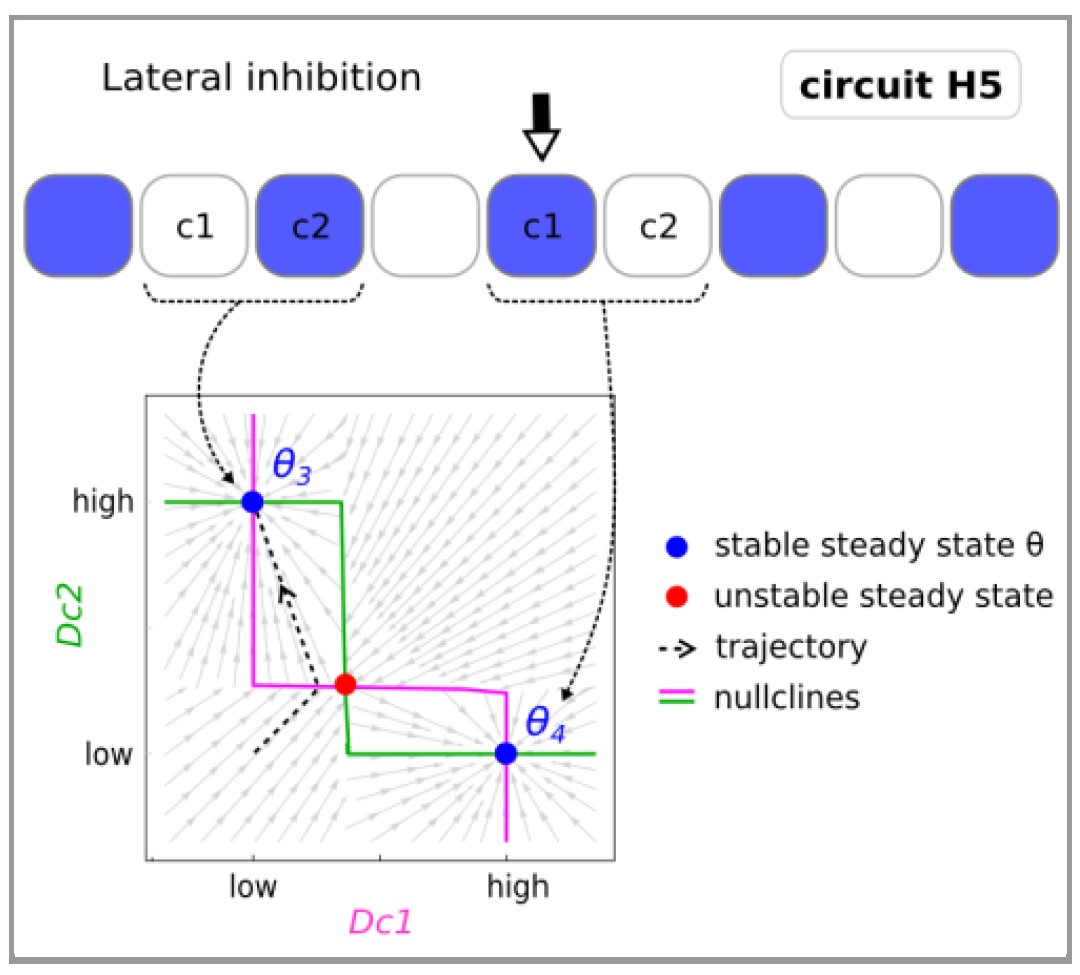
A major challenge in systems biology is to understand the relationship between a circuit's structure and its function, but how is this relationship affected if the circuit must perform multiple distinct functions within the same organism? In particular, to what extent do multi-functional circuits contain modules which reflect the different functions?

Here, we computationally survey a range of bifunctional circuits which show no simple structural modularity: They can switch between two qualitatively distinct functions, while both functions depend on all genes of the circuit.

Our analysis reveals two distinct classes: hybrid circuits which overlay two simpler mono-functional sub-circuits within their circuitry, and emergent circuits, which do not. In this second class, the bi-functionality emerges from more complex designs which are not fully decomposable into distinct modules and are consequently less intuitive to predict or understand. These non-intuitive emergent circuits are just as robust as their hybrid counterparts, and we therefore suggest that the common bias toward studying modular systems may hinder our understanding of real biological circuits. 


Speaker: Gonzalo Parra (Barcelona Supercomputing Centre)
Date: 09/03/2023
Time: 10AM CET

Energetic local frustration offers a biophysical perspective to interpret the effects of sequence variability on protein families. Here we present a novel methodology [1] to analyze local frustration patterns within protein families that allows us to uncover constraints related to stability and function, and identify differential frustration patterns in families with a common ancestry. We have analyzed these signals in very well studied cases such as PDZ, SH3, alpha and beta globins and RAS families. Recent advances in protein structure prediction make it possible to analyze a vast majority of the protein space. An automatic and unsupervised proteome-wide analysis on the SARS-CoV-2 virus demonstrates the potential of our approach to enhance our understanding of the natural phenotypic diversity of protein families beyond single protein instances. We have applied our method to modify biophysical properties of natural proteins based on their family properties, as well as perform unsupervised analysis of large datasets to shed light on the physicochemical signatures of poorly characterized proteins such as emergent pathogens.

[1] Freiberger, M. I. et al. The Evolution of Local Energetic Frustration in Protein Families. BioRXiv 2023 at  https://doi.org/10.1101/2023.01.25.525527__;!!D9dNQwwGXtA!UE3kotrrTKNiWH550N-pa-6Kc8waucJ-C3juoSP25bHG02BeQOPcfosnHlpTldII0bj3xUY72VAuJjSm_ph4nv66$


Speaker: Alejandro Torres-Sanchez (EMBL Barcelona)
Date: 02/03/2023
Time: 10AM CET

I will discuss Onsager’s variational principle, an extension by Onsager of the principle of least energy dissipation by lord Rayleigh. Resorting to examples in biology, I will show that this variational approach is a very effective formalism to describe linear and non-linear non-equilibrium processes combining multiple physical phenomena. In particular, I will show how this principle can be employed to derive the governing equations that regulate the fracking of cell adhesions by osmotic pressure. Finally, I will show that this principle provides a direct route for the time and space discretisation of the equations needed for numerical simulations.


Speaker: Bernat Corominas Murtra (University of Graz)
Date: 23/02/2023
Time: 10AM CET                                                                                                                               

The developmental process implies precise but significant changes in the geometry and structure of the embryonic tissues. Recent results show that apparently minor changes in adhesion at the local level of cell-cell contacts trigger deep, non-linear transitions in the topological organization of the whole embryonic tissue and, in consequence, change its material properties and facilitate geometrical deformations. Open questions remain, like the potential existence of causal feedbacks between cell differentiation processes and the potential heterogeneity of topological patterns existing within the tissue. The results presented in this talk are based on the fundamental assumption that predictive frameworks in theoretical biology must explore the connection between different scales of the system. In this particular case, we use topology to establish a bridge between the system’s scales defined by i) the cell level and ii) the tissue level. This enables us to predict global, non-trivial behaviours in tissues from the empirically feasible observables related to the mechanical properties of single cells.


Speaker: Prof. Guillaume Salbreux (University of Geneva)
Date: 13/02/2023
Time: 12.30 PM
Location: Ramon y Cajal Room, PRBB - C/ Doctor Aiguader 88, 08003 Barcelona

During development, biological systems exhibit large-scale flows coupled to patterning processes, allowing for their self-organisation. In this talk I will discuss two examples of such couplings. I will use an active matter hydrodynamic description of surface flows to explore the dynamics of spontaneous three-dimensional rotation of cell doublets, and how the shape of the cell-cell interface of these doublets can be understood from the Curie principle. I will then discuss the relative role of cellular flows and dynamics of cell fate change in the formation of the vein pattern in Drosophila pupal wings. I will propose a minimal biophysical description of the process of vein refinement to a precise width.


Speaker: Rosa Martinez-Corral (CRG)
Date: 09/02/2023
Time: 10AM CET

Molecular binding is central to cellular regulation, from ligands that bind to receptors, to transcription factors that bind DNA. In this talk I will discuss recent theoretical work on the functional capabilities of binding-based regulatory systems, motivated by the transcriptional control of the model Drosophila gene hunchback by Bicoid. On the one hand, I will discuss the capabilities of allosteric conformational ensembles to integrate information through binding cooperativity. On the other, I will describe a fundamental limit to the generation of sharp sigmoidal responses in the absence of energy expenditure. These findings reveal general regulatory principles in transcription and beyond.